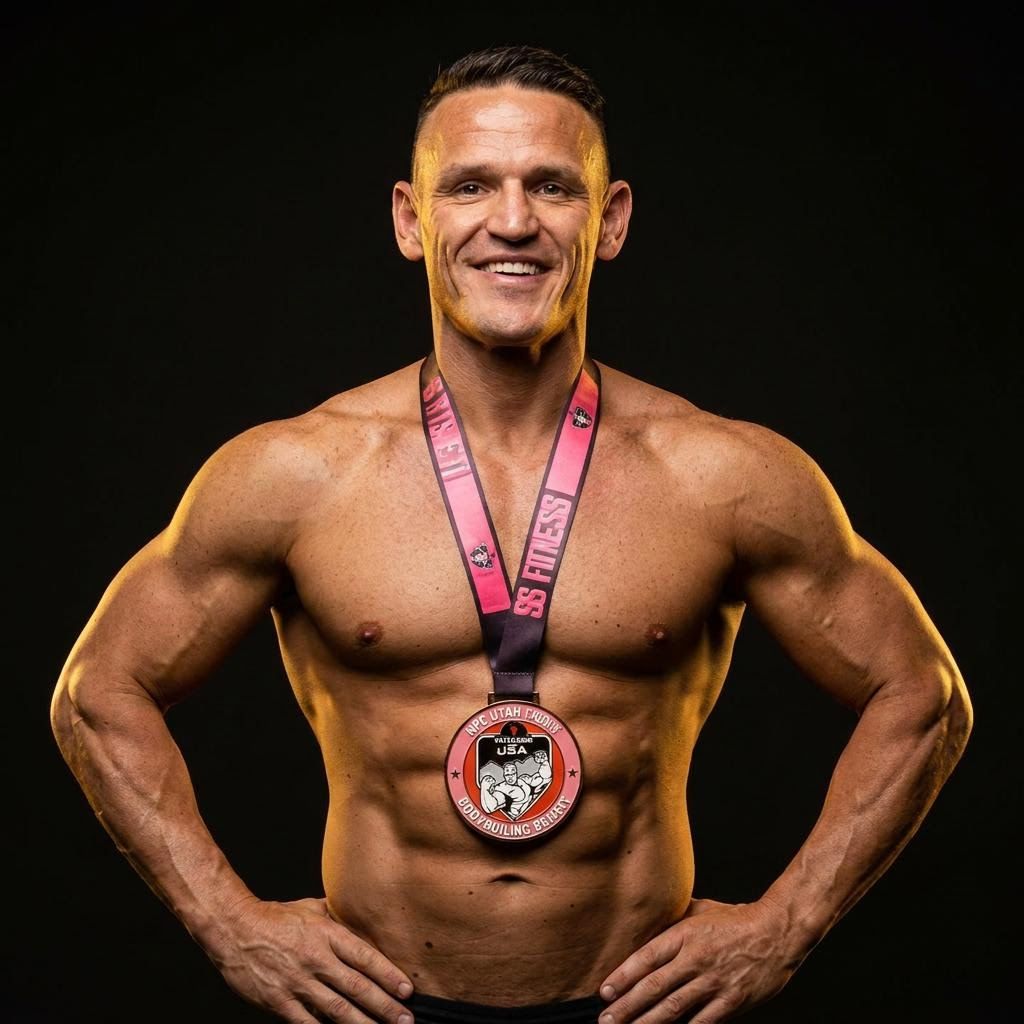
Debuted in 2019, self-coached, in Men's Physique — a division that rewards overall presentation, conditioning, and stage command over raw mass. First, third, and fifth place finishes out of the gate, with no coach and no shortcuts. By the 2024 NPC Utah Classic, the record included two first-place finishes and a second in NPC Classic Physique — a division built around a more complete, classic bodybuilding look: real mass, held together with real proportion, not just conditioning alone. Competing seriously in masters bodybuilding across both divisions wasn't an accident — each one demanded something the other didn't.
Two different judging standards, one body
Men's Physique judges stage presence and conditioning above all else — how the physique presents, not just how big it is. NPC Classic Physique asks a different question: does the physique have real mass and does it hold together with genuine proportion and symmetry, not just a lean midsection. Building a system that could actually deliver in both meant the underlying training and nutrition approach couldn't be optimized narrowly for one look. It had to genuinely work across two different standards.
Why that's a harder bar, and a better one
It would have been simpler to pick one division and build everything around it. Competing in both meant the method had to generalize — the same recovery-respecting, joint-conscious training approach that built a Men's Physique-ready conditioning level also had to support the kind of mass and proportion Classic Physique judges reward. That's a genuinely harder standard to clear than optimizing for one look, and it's a big part of why the system works for real coaching clients with different goals, not just one body type.
Five years, two divisions, one documented record
From a self-coached 2019 debut to podium placings across two divisions in 2024 is a real, five-year documented progression — not a before/after photo with the middle skipped. See the full competition record for both divisions, or the Proof-to-System method for how the underlying approach ties it together.